The Bottleneck shifted
IBM announced Anderon yesterday. Most coverage will miss what it actually is.

In a shift from the typical, IBM, an ex-foundry player, is returning to chipmaking via quantum computing. While most quantum companies are spun out of research labs, Big Blue has decided it is time for an industrial response with CHIPS Act backing.
IBM has been designing processors for decades but has been relying on Samsung for the actual manufacturing since 2015. Yesterday that changed when they created Anderon. No, it is not going to change things on the classical front, but Anderon claims to be the first pure-play quantum foundry.
“Pure play” is the emphasis in the announcement. Google, Rigetti, and other companies have quantum fabs. There are other ways to get quantum chips. What those companies do not offer is neutrality. Rigetti does the full stack. They build quantum computers too. Handing your designs to Rigetti means handing them to a competitor. Anderon is disconnected from those politics. Anything in the announcement that implies it is more than that is marketing copy.
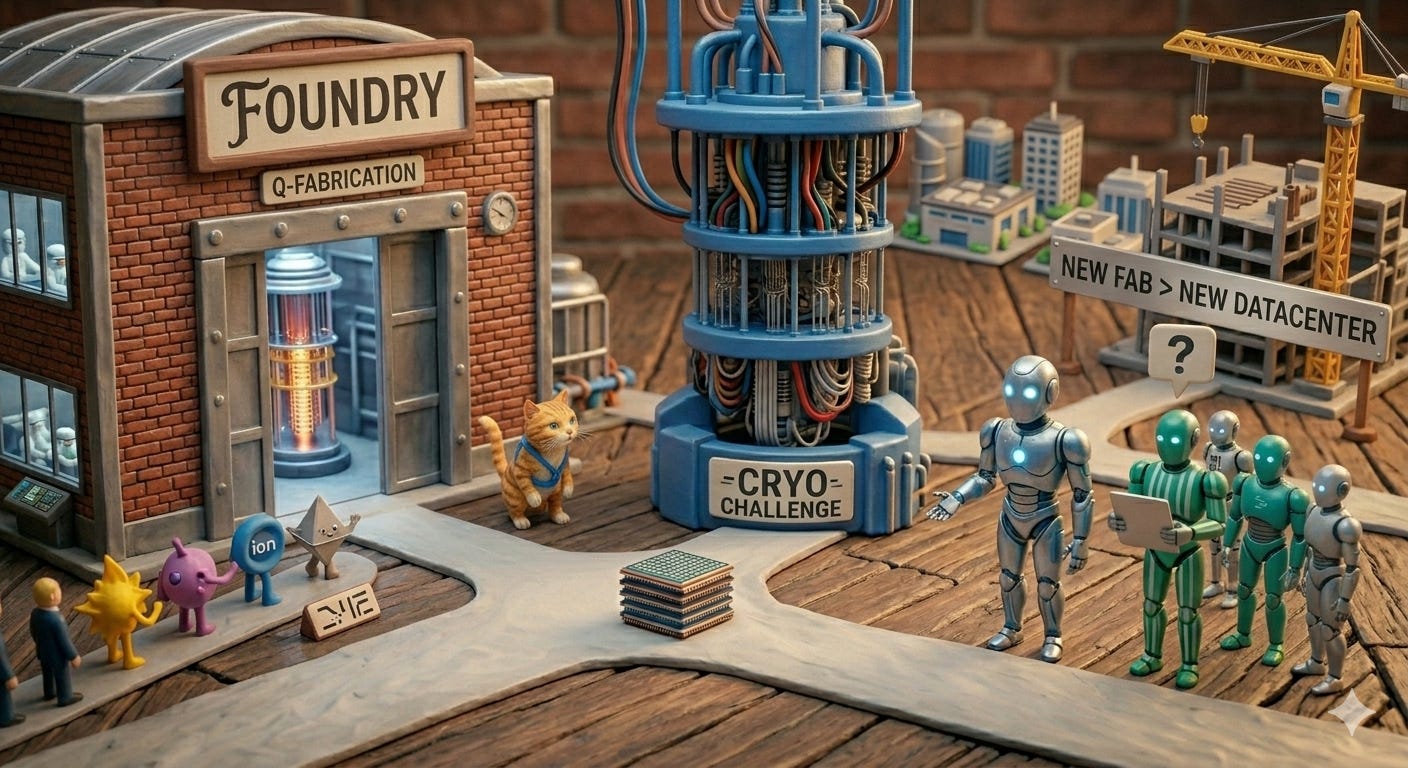
On the face of it, this means the bottleneck is moving from making chips, a labor-intensive process requiring deep experience and extremely controlled conditions. However, in the case of superconducting quantum computers, their primary focus, it only widens the bottleneck. This is a help for one moment: manufacturing. Long term, and in many ways the worse bottleneck, is the cryogenics. Large, high-maintenance devices requiring expertise to use and run.
Improvements in cryogenics will be the bigger bottleneck shift.
It also allows IBM to bet more broadly on quantum, not just on IBMQ. These fabs, while typically focused on superconducting, can also handle some photonic and trapped ion work, and it is easier to pivot than build from scratch. This is a bet on the quantum ecosystem as a whole, especially as it becomes clear that one modality is not the obvious best option. Each type retains advantages and disadvantages, leaving room for each to coexist in its own niche.
The most important thing, though, is that new fabs are being built. The world could use those. There are 476 semiconductor fabs worldwide. Around 78 are in the US, and most do not do logic chips. Memory, RF, and power all require chips with unique constraints. Accelerometers are in nearly every device. LEDs and radar require processes that would not work on a logic chip. This is not a new company chasing a market that does not exist. It is a statement that the US should have more manufacturing capacity in the current era.
A new fab will do more for the economy and national security than a new datacenter.
I’m co-founder of Quickly Quantum, a photonic edge quantum computing company. I understand this space from the inside, not just as an observer. When I advise organizations on quantum readiness, I’m drawing on what it actually takes to build this technology.
I’m now available for a small number of fractional advisory engagements. If your organization is navigating quantum readiness, post-quantum cryptography migration, or trying to build an informed position on where this technology actually is versus where the headlines say it is, that’s the area I work
If that sounds like something worth a conversation, you can find my page here.