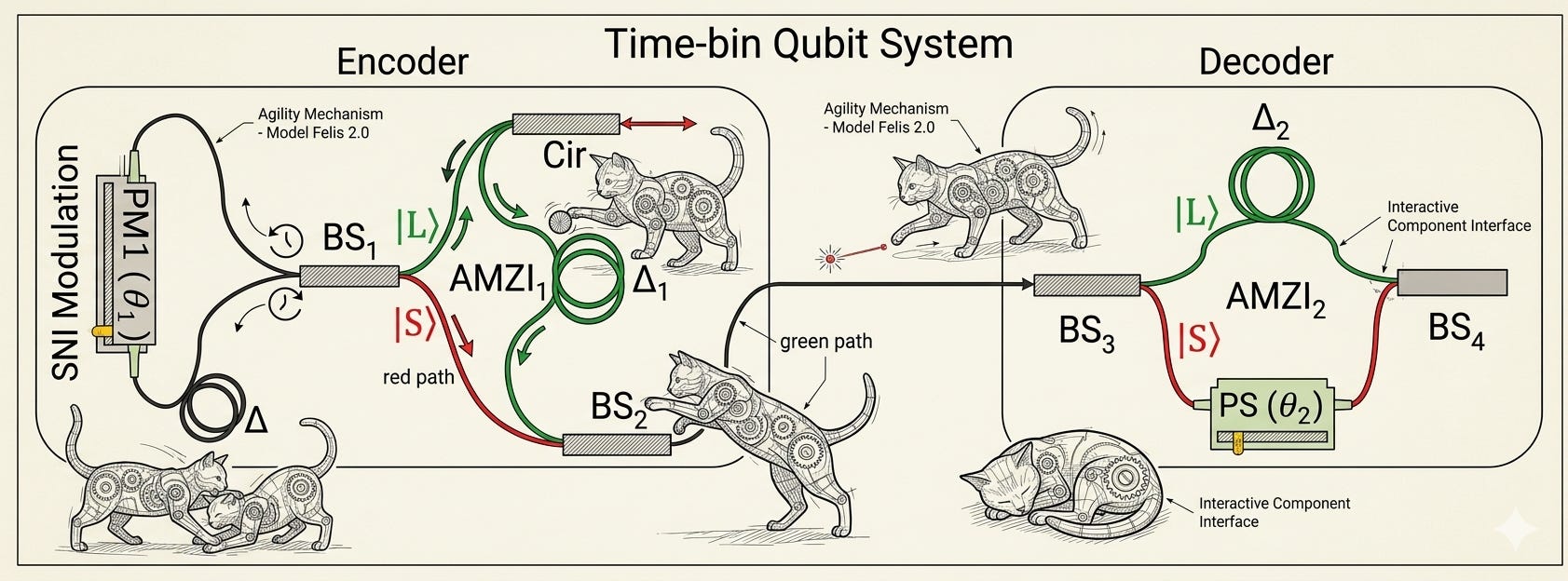
Time Bin Quantum Communication
And a bigger improvement to quantum communication.

Six Hours
A paper updated this month demonstrates 120 kilometers of quantum key distribution with six continuous hours of operation and no manual adjustment. The distance isn’t the story. The record is ten times that.
The six hours is the story, and not for the reason you might think.
Six hours of continuous single-photon operation is not impressive by cloud standards. It is not even close. What matters is that before this paper, you couldn’t have both long operation time and single-photon operation simultaneously. You picked one. Two technologies, working together for the first time, stopped making you choose.
Time-bin qubits unlock stable operation
Most QKD schemes encode information in the polarization of a photon, the angle at which it travels through fiber. The problem is that fiber optic joints flex with temperature. A receiver can’t distinguish a photon that’s supposed to arrive at three degrees from one that drifted there through thermal noise, and checking would collapse the quantum state and destroy the information.
Time-bin encoding sidesteps this entirely.
Instead of angle, information is encoded in timing. Think of it as boxes arriving one after another: a photon in the first box is a one, a photon in the second box is a zero. If a photon falls outside its box, the system knows something went wrong and can adjust. Polarization can’t tell you that. Time bins can. This is a hidden advantage of the encoding scheme, and it’s what makes stable long-duration operation possible.
Single photons make the calibration work
Most QKD schemes use faint lasers. Sometimes they send a single photon, sometimes three, sometimes none. You can’t tell from the outside.
This creates two problems.
First, calibration is difficult when the bins are randomly empty or overfull. If you don’t know when a photon is coming, you can’t reliably calibrate the timing windows around it. Second, multiple photons create a security vulnerability. An attacker can split off one photon and read it without disturbing the others, going undetected in a scheme designed specifically to detect eavesdroppers.
A true single-photon source eliminates both problems. You know exactly when a photon is coming. The bins calibrate cleanly. The attack surface shrinks.
Single-photon sources are a major research area precisely because of these advantages. This paper demonstrated a working implementation at meaningful range. That matters.
The two improvements are synergistic
Time bins work better when you know exactly when the photon is arriving. Single-photon sources work better when the encoding scheme can detect and correct for timing errors. Together they stabilize each other in a way neither does alone. Six hours of uninterrupted operation is the result of that combination, not either technology individually.
But QKD is not the important part of this story
QKD is the prototype technology for the quantum internet.
Long-range, deterministic, stable quantum communication is the actual goal, for networked quantum computers and distributed quantum sensors. Those applications matter far more than key distribution, which has a fundamental problem: it detects eavesdroppers by being disrupted by them. Detection via denial of service is a poor security model.
Quantum sensors and networked quantum computers are the essential research areas. QKD is where the field learned to walk.
What this paper demonstrated is that stable, single-photon quantum communication at meaningful range is more tractable than it was last month. Two technologies that individually existed for years turned out to be more powerful in combination than either was alone.
I work at the intersection of quantum technology, AI systems, and the organizations trying to absorb them. I’m co-founder of Quickly Quantum, a photonic edge quantum computing company, which means I understand these constraints from the inside.
If this post landed because it’s your industry, that’s the right instinct. Reply here and tell me where you are with it.